

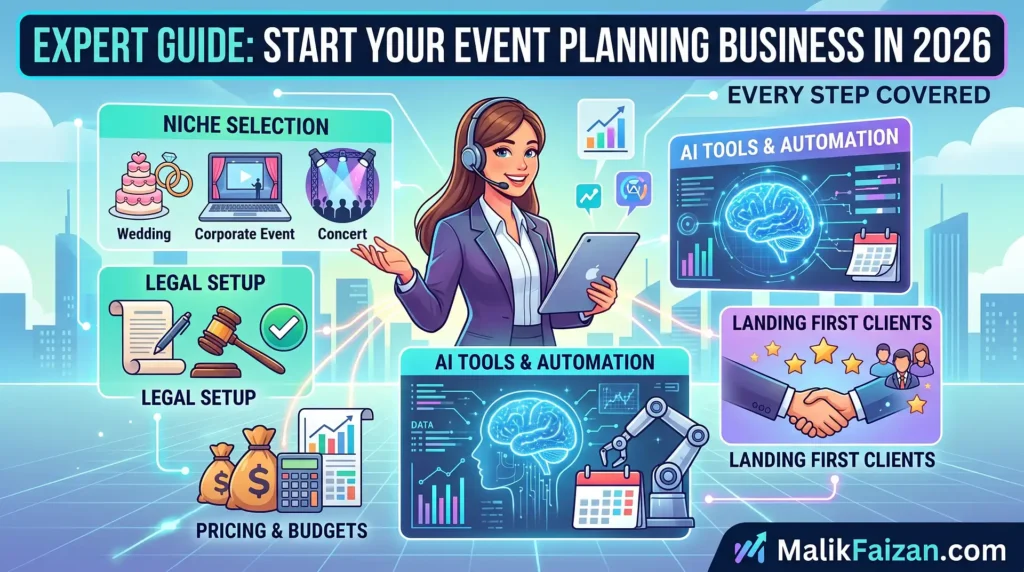
Why 2026 Is a Powerful Year to Start an Event Planning Business
The global events industry is projected to reach $2.5 trillion by 2035, growing at a compound annual rate of 6.8%. Corporate event spending is rising sharply, with costs reaching $169 per attendee per day in 2026. In-person events have reclaimed their dominant position — a striking 97.4% of event professionals rated in-person events as “very important” or “moderately important” to their strategy in 2026, up from 95.4% in 2025.
Perhaps most telling: 85% of meeting professionals say they’re optimistic about 2026 — the highest reading in five years. The meetings and events sector generated more than $126 billion in travel-related spending in the U.S. in 2024 and directly supported nearly 620,000 American jobs.
Well-managed event planning businesses achieve net profit margins of 15–25%. Solo planners focused on weddings or corporate events regularly earn six figures. And startup costs are among the lowest of any service business you could launch.
The opportunity is real. The market is growing. Skilled, organized, client-focused planners are in demand. What you need now is a clear roadmap to take advantage of it.
Step 1: Understand What This Business Actually Involves
A lot of people romanticize event planning. They imagine beautiful tablescapes, grateful clients, and glamorous venues. That part exists. But so does the 10:30 PM text from a vendor canceling 18 hours before the event. So does the spreadsheet with 340 line items that’s due by Friday. So does working every major holiday because that’s exactly when clients schedule events.
This is not a reason to avoid the business. It’s a reason to enter it with clarity.
Event planning means managing every detail of an experience from first concept to final vendor payment. As a professional planner, you’ll be responsible for:
- Consulting with clients to understand their vision, goals, and budget
- Sourcing, vetting, and negotiating contracts with vendors — caterers, photographers, florists, AV teams, rental companies, venues, and more
- Building and tracking budgets so nothing goes over without the client knowing
- Creating detailed timelines and keeping every moving part on schedule
- Managing permits, insurance, and compliance for each specific event
- Being physically present during the event to handle anything that goes sideways
- Following up after every event to close out contracts, gather testimonials, and refine your process
The work happens months before — and sometimes weeks after — the event itself. Evenings and weekends are your core business hours. If that reality fits your life or you’re willing to build your life around it, you’re already ahead of most people considering this path.
Who is genuinely built for this?
The planners who thrive long-term share a specific combination of traits: relentless organizational ability, genuine warmth with clients, creative vision, calm problem-solving under extreme pressure, strong negotiating instincts, and an almost irrational attention to detail. If your friends describe you as “the one who always has it together,” pay attention to that.
Step 2: Get Real on the 2026 Industry Landscape
2026 is not 2019. The event industry has transformed, and the planners building successful businesses today understand exactly how. Here are the shifts reshaping the field right now:
AI is moving from experimentation to expectation. Roughly 50% of meeting professionals are now using AI somewhere in their event planning and execution. The 28% of planners who name AI adoption as a top priority in 2026 aren’t chasing novelty — they’re using it to automate tedious tasks, analyze attendee data, write first drafts of vendor communications, generate event descriptions, and produce post-event reports. Planners who treat AI as a productivity partner are operating at a measurably different level. If your competitors are using AI to manage 40% more events with the same time investment, that’s not a technology conversation — it’s a business survival conversation.
Hyper-personalization is now the baseline. Attendees in 2026 — especially the growing Gen Z and Millennial professional audience — expect experiences that feel built specifically for them. The era of one-size-fits-all events is over. Clients are increasingly willing to pay premium rates for planners who can deliver hyper-personalized touches, from custom guest journeys to curated vendor selections that feel genuinely aligned with their brand or personal aesthetic.
Hybrid events are mainstream, not experimental. More than 123 million hybrid events took place in 2025, making it the fastest-growing segment in the industry. A significant portion of the 2026 market expects flexible attendance options. Planners who understand how to design and execute hybrid events — managing both in-room and remote audiences simultaneously — have access to a client base that’s dramatically larger than planners limited to in-person only.
Sustainability and purpose-driven events are becoming baseline expectations. Surveys show that events failing to demonstrate inclusivity and sustainability are alienating a meaningful portion of potential attendees. Corporate clients increasingly require green event practices from their vendors. Understanding eco-friendly production, responsible sourcing, and how to communicate your sustainability commitments isn’t optional anymore — it’s part of your value proposition.
Micro events are gaining serious traction. Smaller, more focused gatherings — workshops, curated networking dinners, executive roundtables — are delivering stronger ROI for many clients than large-scale productions. This is genuinely good news for new planners: micro events are accessible starting points that build your portfolio without requiring enormous resources.
Budget discipline is the new competitive expectation. With 61.9% of event professionals naming budget constraints as a top challenge in 2026, clients are scrutinizing value more carefully than ever. The planners winning the most business are those who can clearly demonstrate ROI — how the event served a measurable business or personal goal, not just how it looked.
Understanding this landscape doesn’t just make you smarter. It makes you more valuable to clients who need someone who actually gets where the industry is going.
Step 3: Choose Your Niche With Precision
Trying to be everything to everyone is the fastest path to being nothing to no one. Choosing a specific niche builds your reputation faster, sharpens your vendor network, makes your marketing dramatically more effective, and positions you as an expert worth paying premium rates to.
The most in-demand event planning niches in 2026:
Wedding and Engagement Events — consistently among the highest-revenue niches, driven by emotional stakes and high client investment. Full-service wedding planners earn some of the highest per-event fees in the industry.
Corporate Events — conferences, sales kickoffs, product launches, executive retreats, team off-sites, and corporate galas. The number of internal team meetings and corporate gatherings is climbing year over year. Corporate clients often become repeat clients, and corporate budgets are typically larger than social event budgets.
Hybrid and Virtual Events — with over 123 million hybrid events in 2025 and virtual events growing at a 22.5% CAGR, this niche is exploding. Requires tech fluency but commands strong fees and reaches a nationwide (or global) client base.
Social Celebrations — milestone birthdays, anniversaries, baby showers, quinceañeras, retirement parties. Highly personal, referral-driven, and accessible as an entry point.
Nonprofit and Fundraising Events — galas, auctions, awareness campaigns, benefit concerts. Often run on tighter budgets, but building a reputation in this niche leads to consistent annual repeat business.
Luxury and High-End Events — VIP experiences, destination weddings, exclusive brand activations, ultra-premium corporate events. Requires an elevated aesthetic, impeccable vendor network, and strong discretion. Premium pricing.
Micro Events and Executive Gatherings — workshops, curated dinners, focused networking events. Growing rapidly in 2026 as clients pursue deeper connection over scale.
Sustainable and Eco-Conscious Events — a fast-emerging niche driven by corporate ESG commitments and environmentally aware clients. Early movers in this space are establishing genuine competitive advantage.
How to make your choice:
Start with what genuinely excites you — you’ll be doing this work at 9 PM on a Saturday, and passion makes that sustainable. Then validate against your local market: research three to five competitors in your area, identify gaps, and find the intersection of what clients need and what no one is doing particularly well. That gap is your entry point.
Step 4: Build the Skills That Actually Win Clients
Here’s the honest truth most content leaves out: clients don’t hire credentials. They hire confidence, competence, and the evidence of past results. A degree helps, but it’s not the gate.
Core skills you need to develop:
Budget management — you’re managing other people’s money, often tens of thousands of dollars. Errors are expensive and relationship-ending. Learn to build detailed budgets, track actuals versus projections, and present financial updates clearly.
Vendor negotiation — knowing who to call, how to evaluate quality, and how to negotiate favorable terms is worth more than any formal training. It’s also something only experience teaches.
Project management — running multiple events simultaneously, hitting dozens of micro-deadlines per event, and keeping everyone on the same page requires true systems, not heroic effort.
Contract writing and comprehension — every engagement needs a written contract. Learning to write clear, protective agreements is both a legal necessity and a client trust-builder.
AI and tech fluency — in 2026, this is a core skill. Planners using AI tools to draft communications, analyze event data, automate follow-ups, and generate proposals are operating more efficiently than those who aren’t. This is not going away.
Client communication — clients should feel completely confident, never chasing you for updates. Setting communication rhythms and proactively delivering information before it’s requested is what separates good planners from great ones.
How to build experience before you have paying clients:
Shadow an established planner in your area — most are open to this if you offer genuine help. Volunteer to plan events for nonprofits, faith communities, or local organizations. Offer to coordinate a friend or family member’s event at cost. Assist with styled shoots to build visual portfolio content. Two or three real events under your belt — even unpaid ones — change how you present yourself and how clients perceive you.
Certifications worth considering in 2026:
- Certified Special Events Professional (CSEP) from the International Live Events Association (ILEA) — the benchmark for social and special event planners
- Certified Meeting Professional (CMP) from the Events Industry Council — the gold standard for corporate meeting and convention planners
- Digital Event Strategist (DES) from PCMA — increasingly relevant in a hybrid/virtual event world
- University programs in event management, hospitality, or marketing also build a strong foundation
Certifications don’t guarantee clients. But they help you win the comparison when a client is deciding between two planners they like equally.
Step 5: Write a Business Plan That Actually Guides You
Your business plan is not a document you write once and file away. It’s a working tool — a place to record the clarity you’ve built so you can refer back to it when decisions get hard, which they will.
Keep it practical and specific. Here’s what yours needs to include:
Executive Summary — What you do, who you serve, and what makes you different. Write it last, even though it goes first.
Business Overview — Your business name, legal structure, location, and operating model (home-based, office, hybrid).
Niche and Services — Exactly which types of events you’ll plan, and what service tiers you’ll offer. Day-of coordination? Partial planning? Full-service? Virtual event design? Be specific.
Market Research — Who are your top three to five local competitors? What do they charge? What do they do well? What do they do poorly? What’s not being served in your market?
Target Client Profile — A clear picture of your ideal client: their demographics, event budgets, values, how they find vendors, and what they’re most worried about when hiring a planner.
Marketing and Client Acquisition Plan — Exactly how you’ll get clients. Which platforms, which tactics, which referral relationships, which directories. Not vague (“social media”) — specific (“post three times per week on Instagram, maintain a Pinterest board updated monthly, list on The Knot within 30 days of launch”).
Pricing Structure — Your fee model, your rate card, and your package descriptions.
Startup Budget and Financial Projections — What it costs to launch, what you need to earn monthly to cover your expenses, and when you realistically expect to reach profitability.
Operations Plan — How you’ll manage events from inquiry to final invoice. What software you’ll use. What your workflow looks like. Whether you’ll work alone or bring in contractors.
Growth Plan — Where you want to be in 12 months and 36 months. When you’ll hire. When you’ll raise rates. Which markets or niches you’ll expand into.
Useful tools: Score.org offers free mentoring and business plan templates. LivePlan and Notion also have event-specific templates that save significant setup time.
Step 6: Handle the Legal and Financial Foundation
This is the step most aspiring planners delay and then regret. Get it right at the start, and it protects everything you build from here forward.
Choose Your Business Structure
Sole Proprietorship — The simplest option. You and the business are legally the same entity, which means your personal assets (savings, home, car) are exposed if something goes wrong at an event. Fine for very early testing; not recommended as a permanent structure.
LLC (Limited Liability Company) — The right choice for most event planners. An LLC legally separates your personal finances from your business, protecting your personal assets in a lawsuit or financial dispute. It also provides tax flexibility. Filing costs range from $50–$300 depending on your state.
S-Corporation or Partnership — Better suited for planners scaling to higher revenues or bringing in business partners. Consult an accountant before going this route.
The practical recommendation: Form an LLC. It’s affordable, straightforward, and gives you the legal protection this industry requires.
Register, File, and Open Your Accounts
- Register your business name with your state’s Secretary of State office
- Apply for a free Employer Identification Number (EIN) through IRS.gov — this is your business’s tax ID and is required to open a business bank account
- Open a dedicated business checking and savings account — never mix personal and business funds
- Obtain a general business license from your city or county (requirements vary — check your local government’s official website)
Understand Event-Specific Permits
If a client’s event involves alcohol, you’ll need a temporary permit from your state’s Alcohol Beverage Control agency — this can take weeks and must be built into your timeline. Large-scale events may require permits from the local health department (food service) or fire marshal (venue capacity). Part of your professional value is knowing these requirements and guiding clients through them proactively.
Get Business Insurance — Before Your First Event
Skipping insurance is one of the most common and costly mistakes new planners make. One incident — a vendor injury, a damaged venue, a guest accident — can create financial liability that ends your business and threatens your personal assets.
Key coverage types for event planners:
- General Liability Insurance — covers bodily injury and property damage at events; starting around $21/month with some providers
- Professional Liability (Errors & Omissions) Insurance — covers financial claims arising from planning errors, miscommunications, or undelivered services
- Commercial Auto Insurance — required if you use your personal vehicle for client work
Get quotes from at least three providers. Several specialize in event industry coverage and can bundle policies at competitive rates.
Set Up Your Accounting System from Day One
Use accounting software — Wave (free), QuickBooks, or FreshBooks — to track every dollar from the start. Set aside 25–30% of every payment for taxes. Hire a bookkeeper once you’re earning consistently; they pay for themselves in tax savings and time recovered. The event planners who build lasting businesses treat the financial side with the same discipline they bring to planning events.
Step 7: Calculate Real Startup Costs
Event planning is one of the lowest-overhead businesses you can launch — particularly from home. But you still need a clear, realistic budget.
For a lean home-based launch: $2,000–$7,000 For a fuller agency-style launch with premium tools and marketing: $5,000–$30,000
Here’s a realistic breakdown:
| Expense Category | Estimated Cost (2026) |
|---|---|
| Business registration / LLC filing | $50–$300 |
| EIN application | Free |
| General liability insurance (annual) | $400–$750 |
| Professional website (design + hosting) | $500–$3,000 |
| Logo and branding design | $200–$1,500 |
| Event management software (annual) | $600–$2,000 |
| AI productivity tools | $200–$600/year |
| Business cards and print materials | $100–$300 |
| Professional email and Google Workspace | $180–$300/year |
| Initial marketing (social ads, directory listings) | $300–$1,000 |
| Professional photography (portfolio shoot) | $300–$800 |
| Certifications (optional) | $300–$1,500 |
| Estimated Total (Home-Based Launch) | $2,000–$8,000 |
How to reduce startup costs without cutting corners:
Work from home initially — the overhead difference is enormous. Use free tools like Canva, Google Workspace, and Wave before graduating to paid alternatives. Build your portfolio through volunteer and discounted events before charging full rates. Use Instagram and Pinterest organically before investing in paid advertising. More than 70% of successful event planning startups began from home offices.
Step 8: Price Your Services Confidently
Underpricing is the most common and most damaging early mistake. Charging too little doesn’t attract grateful clients — it attracts price-sensitive clients, trains the market to see you as a budget option, and leaves you burning out on volume before you ever build momentum.
Price based on the value you deliver, not your imposter syndrome.
The Five Pricing Models Event Planners Use
1. Percentage of Total Event Budget (Industry Standard) You charge a percentage of the total event cost as your planning fee. The industry standard is 15%, with a range of 10–20% depending on event complexity and your experience level. This model is transparent, scales with event size, and is widely understood by clients.
Example: A $50,000 corporate gala at 15% = $7,500 planning fee
2. Flat Fee / Package Pricing You offer defined service packages at fixed prices — day-of coordination, partial planning, full-service planning, add-ons. No surprises for the client, no ambiguity for you. This model works especially well for wedding and social event planners.
Example: Day-of coordination from $1,500 | Partial planning from $3,000 | Full-service planning from $5,000
3. Hourly Rate You charge by the hour for your time. In 2026, rates range from $25–$50/hour for new planners to $100–$150+/hour for experienced specialists in high-demand markets. This works well for consulting engagements and smaller advisory services.
4. Per-Head / Per-Attendee Pricing Less common, but useful for large-scale events where the scope directly correlates with guest count — conferences, galas, large corporate events.
5. Monthly Retainer Ideal for corporate clients who host regular events throughout the year. The client pays a fixed monthly fee for a defined number of planning hours or services. This is one of the most powerful income stability tools available to event planners — it creates predictable recurring revenue that smooths out seasonal slow periods.
2026-Specific Pricing Guidance
- Corporate events can command approximately 30% more than comparable social events
- Hyper-personalization is a legitimate premium — clients increasingly pay higher rates for planners who offer deeply customized experiences
- Collect 25–50% deposit upfront before beginning any work — this is standard industry practice and protects you financially
- Account for overhead — insurance, software, gas, communication tools — typically 4–5% of the event budget; build this into your pricing
- Raise your rates when your calendar is consistently full — this is the most underutilized growth lever in the industry
Step 9: Build Your Brand for the 2026 Market
Your brand is not your logo. It’s the full impression clients get of working with you — before they ever speak to you. In 2026, that impression forms almost entirely online.
Choose and Secure Your Business Name
Pick a name that is memorable, reflects your niche and style, and passes three practical tests:
- Available as a business name in your state
- Available as a .com domain name
- Available as a consistent handle on Instagram, Pinterest, LinkedIn, and Facebook
Check all three before committing. A mismatch across platforms creates unnecessary friction.
Build a Website That Converts
Your website has one job: convert interested visitors into inquiry submissions. To do that, it needs:
- A clear, specific statement of what you do and who you serve (not “creating memorable moments” — say “full-service wedding planning in Chicago starting at $5,000”)
- Your service packages with enough detail that clients understand what they’re getting
- A portfolio of past events with high-quality photography
- Client testimonials with real names and event types
- A simple, low-friction contact form
- An “About” page that builds trust and personal connection
A clean three-to-five page website on Squarespace or Wix, done well, outperforms a flashy ten-page site done carelessly. Budget $500–$2,000 and prioritize photography over graphic complexity.
Master the Platforms That Matter in 2026
Instagram — still the primary discovery platform for event planners. Post event photos, vendor spotlights, behind-the-scenes stories, and process content consistently. Use Reels for maximum reach.
Pinterest — an underused goldmine. Couples planning weddings and corporate teams researching venue aesthetics search Pinterest constantly. Create boards that represent your style, link back to your website, and watch the organic traffic build over months.
LinkedIn — essential if you’re targeting corporate clients. Build a professional profile, post thought leadership content, and connect directly with event coordinators, marketing directors, and HR leaders at target companies.
TikTok — a growing opportunity for planners willing to show personality and process. Behind-the-scenes event day content and “things clients don’t see” formats consistently perform well.
Google Business Profile — create one immediately. This is how local clients find you when they search “event planner near me.” Fill out every field, upload photos, and build your review count from the first event onward.
Use AI to Elevate Your Content — Authentically
In 2026, the planners building the strongest online presence are using AI to draft content, generate caption ideas, repurpose single events into multiple content pieces across platforms, and analyze what resonates. This doesn’t mean your content sounds robotic — it means you show up more consistently with less friction. Use AI as a starting point; your voice, experience, and personality make it yours.
Step 10: Build Your Vendor Network — Your Real Competitive Advantage
This is the insight that transforms average planners into exceptional ones: your vendor network is worth as much as any skill you develop. Experienced clients don’t just hire your organizational ability — they hire your relationships.
A trusted, pre-vetted network of photographers, caterers, florists, AV technicians, rental companies, and venue contacts means you can deliver higher quality, negotiate better pricing, solve problems faster, and make introductions that make clients feel they’re getting access to something exclusive.
How to build this network from scratch:
- Attend local wedding expos, business networking events, and industry trade shows
- Join ILEA (International Live Events Association) or MPI (Meeting Professionals International) — the networking alone justifies the membership fee
- Reach out directly to vendors you admire. Most are happy to connect with someone who might become a referral source. Coffee conversations build business relationships.
- Assist an established planner in exchange for introductions. Two or three events alongside a veteran compresses years of relationship-building into a few months.
- Join local Facebook groups and Slack communities for event professionals — these are where the real daily networking happens
The reciprocity principle: Refer clients to vendors who do excellent work. They will send clients back to you. This flywheel — when built intentionally — becomes a client acquisition machine that runs on goodwill and reputation.
Step 11: Land Your First Paying Clients
Every new planner faces the same chicken-and-egg problem: clients want to see your portfolio, but you can’t build a portfolio without clients. Here’s how to solve it.
Build the Portfolio First
- Volunteer events: Plan a charity fundraiser, community event, or church gathering at no charge in exchange for professional photos and a written testimonial. One great event with strong documentation is worth more than ten undocumented events.
- Friends and family at cost: Offer to plan a milestone birthday or small wedding for someone in your circle at materials cost only. Make it exceptional.
- Styled shoots: Collaborate with a photographer and florist who are also building their portfolios. Design and photograph a mock event that looks exactly like your ideal client’s event. No guests required.
Once you have three to five high-quality event photos and two or three written testimonials, you have a portfolio.
Active Client Acquisition Strategies for 2026
Warm network outreach — Contact your personal and professional network directly. Tell everyone what you do. Many first clients come from people who simply didn’t know you were available. Don’t be vague: “I just launched my event planning business and I’m booking corporate events and social celebrations for 2026. Would love to chat if you or someone you know needs a planner.”
Direct corporate outreach — Build a list of local businesses with 25+ employees. Reach out to office managers, executive assistants, and HR directors — they’re typically responsible for company events and often have no established planner relationship. Send a personalized email, follow up by phone, offer a free consultation.
Venue and vendor partnerships — Ask to be included on venue preferred vendor lists. Partner with photographers, florists, and caterers who serve your target clients and can refer you naturally.
Directory listings — The Knot, WeddingWire, Thumbtack, and Bark put you in front of clients actively searching for planners. Complete your profile fully, add pricing information, and gather reviews from the moment you complete your first event.
Local SEO and Google Business Profile — Optimize your website for “[your city] event planner,” “[your city] wedding planner,” and related searches. Build your Google Business Profile and gather Google reviews actively.
Referral incentives — Offer clients a meaningful thank-you (gift card, discount on future services) for every successful referral. A client who loved you becomes your most effective marketing channel.
Step 12: Use AI and Technology to Operate at a Higher Level
This section didn’t exist in most event planning guides two years ago. In 2026, it’s essential.
50% of meeting professionals are now using AI in their planning and execution. The 28% who identify AI adoption as a top priority aren’t doing it because it’s trendy — they’re doing it because planners who use AI well serve more clients, make fewer errors, and spend their time on higher-value work.
Where AI delivers real value for event planners:
- Client communications — drafting proposal emails, follow-up messages, and vendor inquiries in seconds rather than minutes
- Event descriptions and marketing copy — generating first drafts of website content, social captions, and promotional materials
- Budget analysis — using AI tools to spot budget risks and model financial scenarios
- Vendor research — accelerating the research process when sourcing new vendors in unfamiliar markets
- Post-event reporting — generating professional event summary reports for corporate clients quickly
- Content repurposing — turning one post-event write-up into Instagram captions, Pinterest descriptions, blog content, and newsletter material simultaneously
Recommended AI-integrated tools for 2026 event planners:
| Category | Tool Options |
|---|---|
| Event Management (with AI features) | HoneyBook, Planning Pod, Cvent, Bizzabo |
| Client Management / CRM | Dubsado, 17hats |
| AI Writing Assistant | Claude, ChatGPT |
| Design and Visuals | Canva (Magic AI features), Adobe Express |
| Project Management | Asana, Monday.com, Notion |
| Budget Tracking | Google Sheets, Airtable |
| Accounting | Wave (free), QuickBooks |
| Social Media Scheduling | Later, Planoly, Buffer |
| Website | Squarespace, Wix, WordPress |
| Virtual/Hybrid Event Platforms | Hopin, Whova, EventsAir |
Start with the tools you’ll actually use. A simple, consistent tech stack you understand beats a sophisticated one you avoid.
Step 13: Deliver Events That Turn Clients Into Advocates
Landing clients is important. Turning them into long-term advocates — clients who rebook, refer everyone they know, and leave you reviews without being asked — is what builds a business that generates income for years.
What separates good event planners from truly exceptional ones:
A master event checklist, customized for every event — nothing should live only in your memory. Document every task, every vendor contact, every deadline, every contingency. Your checklist is your safety net.
Crystal-clear written agreements — every engagement, regardless of size or relationship, needs a detailed contract. Define scope, payment schedule, cancellation policy, vendor responsibilities, and what happens when things change (and they always do).
Proactive communication — clients should never feel like they’re chasing you. Set a communication rhythm at the start (“I’ll send weekly updates every Thursday”), stick to it, and send updates before anyone has to ask.
Contingency plans for every critical element — before the event, know your backup for every key vendor, every critical technology, every essential piece of equipment. Experienced planners don’t hope things go right — they plan for what happens if they don’t.
A thoughtful post-event process — send a thank-you within 48 hours. Follow up for a testimonial within two weeks. Request a Google or directory review with a direct link. Deliver a post-event summary for corporate clients. These final steps determine whether a client becomes an advocate or just a past client.
Step 14: Scale Strategically — When and How to Grow
When your calendar is consistently full, you’re regularly turning down work, and your reputation in your niche is solidifying, it’s time to think about scaling.
The most profitable scaling moves for event planners:
Raise your rates — the most underused growth lever in the industry. If your calendar is booked three months out, your rates are too low. Raise them for new inquiries while honoring existing commitments.
Hire a part-time assistant or second planner — this allows you to take on overflow, serve more clients at the same time, or take on larger events that require additional hands.
Add service tiers — if you’ve offered full-service planning, add partial planning or day-of coordination as accessible entry points. These lower-fee services feed the pipeline for your higher-fee engagements.
Secure corporate retainers — companies with regular event needs (quarterly team meetings, annual conferences, product launches) make ideal retainer clients. A single corporate retainer at $2,000–$5,000/month can stabilize your cash flow through slower seasons.
Expand into adjacent niches — a wedding planner adding corporate clients, or a social event planner adding hybrid events, can access a substantially larger market without starting over.
Scale with discipline. Growing too fast without the systems, staff, and workflows to support it leads to quality failures — and in event planning, quality failures are visible, public, and word-of-mouth damaging in a way that can set you back months.
The Hidden Reasons Event Planning Businesses Fail (And How to Avoid Them)
Most guides focus on how to start. Fewer tell you the honest patterns that cause businesses to plateau or close. These are worth understanding before they become your story.
No written contracts. Every single engagement needs a contract. Without one, scope creep becomes free work, disputes become unresolvable, and clients’ memories of what was agreed upon become wildly optimistic. This is not about distrust — it’s about protecting both parties.
Underpricing as a client acquisition strategy. It backfires almost every time. Budget-conscious clients at rock-bottom rates are often the most demanding. Starting low makes it psychologically and practically difficult to raise rates later. Price based on your value from the beginning.
No income strategy for slow seasons. Corporate retainers, virtual event services, workshops, and advisory consulting are all ways to generate income during the slower months between major events. Plan for seasonality before it surprises you.
Ignoring the business fundamentals. Some planners are gifted creatively but neglect invoicing, tax planning, contract management, and cash flow. These gaps don’t disappear — they compound. Get basic financial systems in place from day one.
No boundaries with clients. Event planning naturally invites 24/7 access. Without deliberate policies — defined response hours, an out-of-office protocol, clear expectations set at onboarding — this career becomes unsustainable fast. Build your professional boundaries early, when it’s far easier to establish them than to try to install them later.
Skipping the portfolio-building phase. Attempting to charge full rates without a portfolio puts you at an immediate disadvantage. Invest three to six months building proof of your ability — through volunteers, styled shoots, or discounted work — before entering the market at full price.
Image Suggestions with ALT Text
- Hero / Featured Image: Event planner reviewing a floor plan with a tablet at a venue ALT: “Event planner reviewing venue floor plan on tablet before a 2026 corporate event”
- Industry Stats Graphic: Infographic showing global events industry growth projections 2026–2035 ALT: “Global event industry market growth statistics from 2026 to 2035”
- Niche Selection Diagram: Visual showing different event planning niches — weddings, corporate, hybrid, micro events ALT: “Event planning niche comparison chart showing weddings corporate events hybrid and micro events”
- Pricing Model Comparison: Clean table or graphic comparing flat fee, percentage, hourly, and retainer pricing models ALT: “Event planner pricing models comparison 2026 — flat fee percentage hourly retainer”
- AI Tools for Planners: Screenshot or illustration of AI-assisted event planning workflow ALT: “AI tools used by event planners in 2026 including HoneyBook Planning Pod and ChatGPT”
- Vendor Network Map: Infographic showing the ecosystem of event vendors a planner coordinates ALT: “Event planner vendor network map showing caterers photographers florists AV teams and venues”
Frequently Asked Questions
How much does it cost to start an event planning business in 2026?
Starting from home, plan to invest $2,000–$7,000 in your first year. This covers business registration (LLC filing runs $50–$300 depending on your state), general liability insurance ($400–$750 annually), a professional website ($500–$2,000), basic branding, event management software, and initial marketing. If you want a more robust launch with a full AI toolkit, premium directory listings, and a professional photo shoot, the realistic budget is $5,000–$10,000. The good news is that event planning has lower startup costs than almost any other service business of comparable earning potential.
Do I need a license or certification to start an event planning business?
A specific “event planner license” generally doesn’t exist, but you’ll need a general business license from your city or county — check your local government’s official website for requirements. If events involve alcohol, a temporary Alcohol Beverage Control permit is required (often taking several weeks to process). While not legally required, professional certifications like the CSEP from ILEA or the CMP from the Events Industry Council significantly increase your credibility and help you win more competitive client contracts.
How do event planners charge clients in 2026?
The five primary pricing models are: a percentage of the total event budget (industry average is 15%, range is 10–20%), flat fee packages, hourly rates ($25–$150+ depending on experience and market), per-head pricing for large events, and monthly retainers for recurring corporate clients. Most established planners use a combination — package pricing for weddings and social events, retainers for corporate clients. Always collect 25–50% upfront before beginning work.
How do I get my first client with no portfolio or experience?
Start by building the portfolio before worrying about paying clients. Volunteer to plan a nonprofit event, an organization’s gathering, or a close friend’s celebration — document everything with professional photography. Participate in a styled shoot with a photographer and florist also building their portfolios. Once you have three to five quality events documented and two or three written testimonials, use your warm network, corporate outreach, Google Business Profile, and directory listings (The Knot, WeddingWire, Thumbtack) to attract paid inquiries. Most planners land their first paying client within 30–90 days of consistent effort.
How long does it take to make money as a new event planner?
Most planners who take consistent action land their first paid client within 30–90 days of launching. Reaching a full-time income level — typically $50,000–$80,000 annually — takes most planners 12–24 months. The timeline accelerates significantly for planners who invest in a specific niche, build their portfolio proactively, establish strong vendor relationships early, and approach client acquisition as a consistent daily activity rather than an occasional one.
Is event planning still profitable in 2026?
Absolutely. The global events industry is on track to reach $2.5 trillion by 2035. Corporate event spending is rising, in-person events have fully reclaimed their strategic importance, and demand for skilled professional planners is growing across every major category — weddings, corporate, hybrid, micro events, and luxury. Well-managed event planning businesses achieve net profit margins of 15–25%. The planners struggling aren’t struggling because the market is weak — they’re struggling because of underpricing, inadequate systems, or inconsistent client acquisition.
What’s the best niche to start with in 2026?
The best niche is the intersection of what genuinely interests you, what your local market needs, and where your competitors are underperforming. Wedding planning and corporate events offer the highest and most consistent revenue in most markets. Hybrid and virtual event planning is the fastest-growing niche with the widest geographic reach. Micro events and sustainable event planning are emerging niches with strong forward momentum in 2026. Choose one niche, build deep expertise, and expand from a position of strength rather than trying to do everything at once.
Do I need to use AI tools as an event planner in 2026?
You don’t need to, but you’ll be at a meaningful competitive disadvantage if you don’t. Roughly 50% of meeting professionals are now using AI in their planning workflows, and 95% of surveyed event teams expect their AI usage to increase in 2026. Planners using AI for client communications, proposal drafting, content creation, and post-event reporting are working more efficiently and serving more clients without adding hours. Start with a tool like Claude or ChatGPT for drafting, and explore AI features built into platforms like HoneyBook or Cvent. Adopt incrementally, focus on the tasks AI does best, and keep your human creativity and judgment at the center.
What software should I use to manage my event planning business?
For client management and contracts, HoneyBook and Dubsado are the most popular choices among independent planners. For full event management (timelines, vendor coordination, guest management), Planning Pod and Cvent are strong options. For project management, Asana or Notion. For accounting, Wave is free and functional; QuickBooks is more powerful. For social media scheduling, Later or Planoly. For hybrid and virtual events, Whova and Hopin. Start with a lean stack — client management + project management + accounting — and add tools as specific needs emerge.
How do I handle the slow season as an event planner?
The most effective strategies are: securing corporate retainer clients (monthly recurring revenue that doesn’t depend on event volume), offering virtual and hybrid event services (no geographic or seasonal limitation), creating and selling educational content (planning guides, checklists, online workshops), and building your marketing infrastructure during slower periods so your pipeline is full when busy season returns. The planners who struggle with seasonality are the ones who treat slow periods as time off rather than time to invest.
Final Word: Your Business Starts With One Honest Step Forward
Every extraordinary event you’ll ever plan starts the same way — as a blank page, a conversation, and someone deciding to trust you with something that matters to them.
The engaged couple trusting you with the most important day of their lives. The executive trusting you with a conference that represents their company’s reputation. The nonprofit director trusting you with one evening to change the trajectory of their mission.
They all need someone who is skilled, organized, creative, honest, and absolutely trustworthy. That person can be you — not someday, not once you feel ready, not after one more course or credential or year of thinking about it.
The event planning industry in 2026 is growing fast. The clients are there. The tools are better than they’ve ever been. The demand for skilled professionals is as high as it’s ever been.
What remains is the decision to begin — to pick your niche, register your business, build your portfolio, and make the first call. Everything else in this guide gets you there. But no guide can make the first move for you.
Start today. Be excellent. Build something you’re proud of.
