

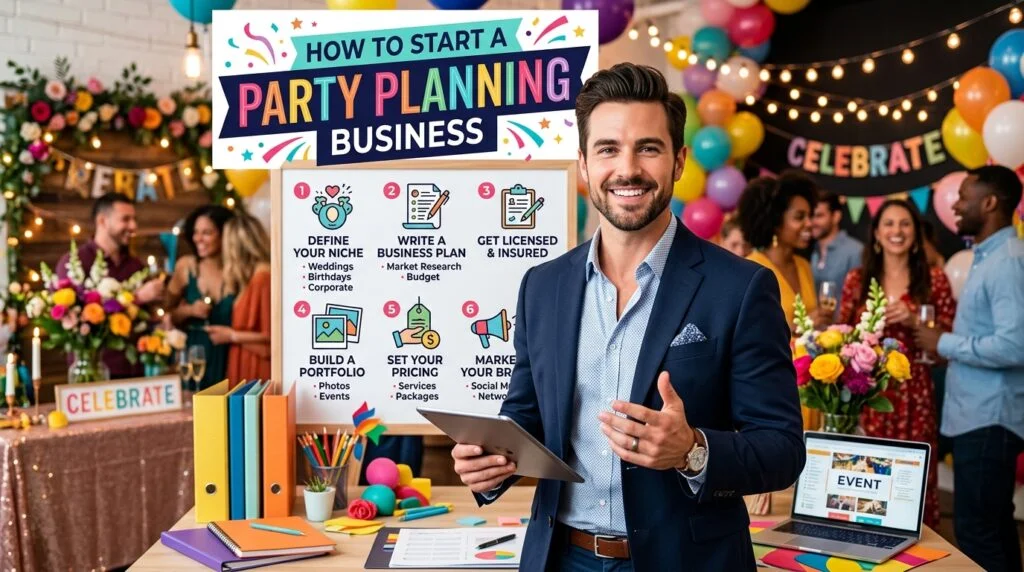
How to Start a Party Planning Business in 2026: The Complete Guide From Zero to Your First Client
People love to celebrate. They always have. They always will.
Birthdays, weddings, baby showers, graduations, retirement parties, corporate galas — celebrations are part of being human. And in 2026, the celebrations are bigger, bolder, and more creative than ever before.
But here’s the secret most people don’t realize: the person who plans the party often makes more money than the person throwing it spends on the cake.
Learning how to start a party planning business in 2026 is one of the smartest, most exciting, and most accessible business moves you can make right now. The barriers to entry are almost nonexistent. You can literally start from your couch tonight.
The U.S. events industry is now valued at over $6.3 billion and climbing. Post-pandemic revenge spending has evolved into a permanent cultural shift — people are prioritizing experiences over things. They want memorable moments. They want Instagram-worthy celebrations. They want stress-free parties where all they have to do is show up and smile.
They need YOU.
Whether you’re a stay-at-home parent looking for a flexible income stream, a college student exploring creative careers, a corporate worker dreaming of an escape, or someone who’s just really, really good at throwing parties — this guide is your blueprint.
I’m going to walk you through absolutely everything. Every single step. Every tool. Every strategy. Every mistake to avoid. By the time you finish reading, you’ll know exactly how to start an event planning business from scratch in 2026.
No fluff. No gatekeeping. Just real, actionable advice.
Let’s get into it.
What Is a Party Planning Business, Really?
Let’s start with the basics. Keep it super simple.
A party planning business is a company that helps people organize and execute celebrations and events. You’re the behind-the-scenes magician. Someone tells you what they want, and you make it happen.
Think of it like this: your client says, “I want an amazing 30th birthday party for my wife. She loves tropical themes and tacos.” You take that vision and turn it into reality. You find the venue. You book the caterer. You design the decorations. You hire the DJ. You coordinate the timeline. You handle the surprises. And on the night of the party, everything goes perfectly — because you planned it that way.
In 2026, party planners handle all sorts of events:
- Birthday parties (kids, teens, adults, milestone birthdays)
- Wedding receptions and engagement parties
- Baby showers, gender reveals, and sip-and-sees
- Graduation celebrations
- Holiday parties (Friendsgiving is HUGE in 2026)
- Corporate events and team celebrations
- Anniversary parties
- Retirement parties
- Sweet sixteens and quinceañeras
- Cultural celebrations and heritage events
- “Just because” parties (a growing 2026 trend)
- Divorce parties (yes, this is a real and growing niche)
- Pet birthday parties (don’t laugh — it’s a $700 million industry)
The beautiful thing? You choose what you want to specialize in. Your business. Your rules.
Why 2026 Is the Best Year to Start a Party Planning Business
Every year, people say “this is the year to start.” But 2026 genuinely has some unique factors working in your favor.
The Experience Economy Is Exploding
According to Eventbrite’s 2025-2026 Trends Report, 78% of millennials and Gen Z prefer spending money on experiences rather than material goods. This number has been climbing steadily since 2020 and shows no signs of stopping. People don’t want another gadget — they want an unforgettable party.
AI Tools Have Leveled the Playing Field
In 2026, artificial intelligence tools have made it easier than ever to run a professional business with minimal overhead. AI can help you write proposals, create mood boards, generate social media content, manage schedules, and even predict budgets. A solo party planner with the right AI tools can now compete with established companies that have entire teams. More on this later.
Social Media Is Your Free Marketing Machine
Platforms like Instagram, TikTok, and the rising star Lemon8 have made it possible to build a massive audience without spending a penny on advertising. One viral party transformation video can bring in dozens of clients overnight. In 2026, the algorithm rewards authentic, creative content — exactly the kind of content party planners naturally create.
Remote and Hybrid Work Has Changed Corporate Events
With 58% of U.S. companies now operating in hybrid or fully remote models (according to Gallup’s 2025 workplace data), corporate event planning has transformed. Companies are spending more on team-building events, in-person retreats, and celebration gatherings specifically because their teams don’t see each other every day. This has created a massive new market for corporate event planners.
Low Startup Costs, High Earning Potential
You can start for under $300. You can earn six figures within two years. The math just works. According to Indeed’s 2026 salary data, event planners in the USA earn an average of $52,000 to $78,000 per year, with top earners in metropolitan areas clearing $120,000+.
The “Micro-Celebration” Trend
In 2026, people aren’t just celebrating big milestones. They’re celebrating small wins, monthly anniversaries, promotions, first days of school, even “survival” parties (celebrating getting through tough times). This trend means more events, more clients, and more opportunities for you.
Types of Party and Event Planning Businesses You Can Launch
Before you start, you need to decide what kind of business you want to build. There are many paths when figuring out how to start an event management business, and each one has its own advantages.
Full-Service Event Planning
You handle absolutely everything from the first phone call to the last piece of confetti being swept up.
What you do: Concept development, venue selection, vendor coordination, budget management, timeline creation, day-of management, and post-event cleanup coordination.
Ideal for: Natural leaders who love managing complex projects.
2026 earning potential per event: $2,500 – $75,000+
Day-of / Month-of Coordination
The client does most of the planning themselves, but you step in during the final stretch to make sure everything goes smoothly. You’re the safety net.
What you do: Confirm vendors, create detailed timelines, manage setup, coordinate the event, troubleshoot problems.
Ideal for: People who thrive under pressure and love being the calm in the chaos.
2026 earning potential per event: $600 – $4,000
Kids’ Party Planning Business
This is one of the hottest niches in 2026. American parents spent over $4.4 billion on children’s birthday parties in 2025, and that number keeps climbing. If you want to know how to start your own kiddies party business, this niche offers steady, repeat business and enthusiastic word-of-mouth marketing.
What you do: Themed party packages, entertainment coordination, decoration setup, activity planning, party favor assembly.
Ideal for: People who love working with families and have a playful, creative side.
2026 earning potential per event: $400 – $3,000
Event Decorating Business
Don’t want to manage entire events? Just want to make spaces look incredible? Learning how to start a small event decorating business lets you focus purely on the visual magic.
What you do: Balloon installations, floral arrangements, table styling, backdrops, lighting design, themed décor, and prop creation.
Ideal for: Artists, crafters, and visual thinkers.
2026 earning potential per event: $250 – $7,000
Event Space Rental Business
If you have property access or investment capital, understanding how to start an event space rental business opens up a passive income stream. In 2026, unique venue spaces — converted warehouses, rooftop gardens, backyard estates, barn venues — are in massive demand.
Ideal for: Property owners or real estate-savvy entrepreneurs.
2026 earning potential per month: $4,000 – $40,000+
Corporate and B2B Event Planning
Companies need events too — and they have bigger budgets. Holiday parties, product launches, conferences, retreats, award ceremonies, and client appreciation events.
Ideal for: Professionally-minded planners comfortable with corporate culture.
2026 earning potential per event: $5,000 – $150,000+
Wedding Planning and Coordination
Weddings remain the crown jewel of the events industry. The average American wedding in 2026 costs approximately $33,000, and couples willingly pay planners 10-20% of their total budget.
Ideal for: Detail-obsessed romantics who can handle high-emotion situations.
2026 earning potential per event: $3,500 – $20,000
Hybrid and Virtual Event Planning (The 2026 Expansion)
This is relatively new and growing fast. Some celebrations now include virtual components — livestreaming for long-distance family members, virtual reality party experiences, and interactive digital elements. Planners who understand both physical and digital event elements have a competitive edge in 2026.
How to Start a Party Planning Business: Your Complete 2026 Step-by-Step Roadmap
Here it is. The full playbook. Follow these steps, and you’ll go from dreaming to doing. This is exactly how to start your own event planning business in today’s market.
Step 1: Research Your Market Like a Detective
Before you invest a single dollar, become a student of your local market. This research phase saves you from expensive mistakes later.
Study your competitors. Google “party planner” + your city. Look at every result. Visit their websites. Check their Instagram and TikTok. Read their Google reviews. Note their prices, their style, their strengths, and their weaknesses.
Identify gaps. Maybe nobody in your area specializes in eco-friendly events. Maybe there’s no planner focused on multicultural celebrations. Maybe all the existing planners are expensive, leaving budget-conscious clients with no options. Find the gap, and fill it.
Know your audience. Who are you going to serve? Be specific. “Everyone” is not an audience. Here are examples of specific audiences:
- First-time parents planning their child’s first birthday in [your city]
- Millennial couples planning intimate weddings under $10,000
- Tech companies in [your metro area] needing quarterly team events
- Families in [your suburb] wanting themed kids’ parties
Research 2026 trends. What’s hot right now?
The biggest party trends in 2026:
- AI-personalized experiences — Using guest data to customize elements of the party
- Sustainable/eco-conscious events — Biodegradable decorations, zero-waste catering, carbon-neutral venues
- Immersive themed events — Going beyond decoration into full sensory experiences
- Nostalgia parties — 90s and Y2K themes are massive in 2026
- Micro-celebrations — Small, intimate gatherings with high-end details
- Interactive food experiences — DIY food bars, molecular gastronomy stations, food art
- Dopamine décor — Bold, bright, maximalist color schemes
- Tech-integrated parties — LED installations, projection mapping, AR photo experiences
- Wellness celebrations — Sound bath parties, yoga brunches, meditation gatherings
- “Unplugged” events — Phone-free celebrations focused on genuine connection
Spend 2-4 weeks on research. Talk to people. Attend local events. Visit venues. The knowledge you gain now will be your foundation.
Step 2: Choose Your Niche and Define Your Services
Based on your research, make your decisions. What will your business do? Who will it serve?
Here’s a framework that works:
I help [specific audience] plan [specific type of event] so they can [specific benefit].
Examples:
- “I help busy parents in Austin plan magical, stress-free birthday parties for their kids so they can actually enjoy the celebration.”
- “I help couples in Miami plan intimate, eco-friendly weddings that are beautiful and sustainable.”
- “I help tech startups in San Francisco plan unforgettable team-building events that boost company culture.”
Write yours down. This becomes your positioning statement — the core message that guides everything you do.
Next, list your specific services. Be detailed:
- Initial consultation (free or paid?)
- Concept and theme development
- Venue sourcing
- Vendor management
- Budget planning
- Timeline creation
- Decoration design and setup
- Day-of coordination
- Post-event cleanup coordination
- Virtual/hybrid event components
You don’t have to offer everything on day one. Start with 3-5 core services and expand as you grow.
Step 3: Write a Simple Business Plan
Don’t overthink this. A business plan isn’t a college thesis — it’s a roadmap. In 2026, the best business plans are lean, focused, and adaptable.
Your plan should cover:
Mission statement: One sentence about why your business exists.
Market analysis: What you learned from your research — your competitors, your target market, market size.
Services and pricing: What you offer and what you charge.
Marketing strategy: How you’ll attract clients (social media, networking, referrals, etc.).
Financial projections: Startup costs, monthly expenses, revenue goals, break-even timeline.
Operations: How your business runs day to day.
Keep it to 3-5 pages. You can always expand later.
Free resources: The SBA (Small Business Administration) at sba.gov has free business plan templates. The SCORE mentoring program connects you with free business advisors. LivePlan offers guided business plan software. These are all fantastic resources for anyone learning how to start a business as an event planner.
Step 4: Pick the Perfect Business Name
Your name is your first impression. Make it count.
2026 naming tips:
- Keep it short. Two to three words max. Short names are easier to remember, easier to spell, and look better on social media.
- Make it searchable. Include a relevant word (events, celebrations, party, gather) so people can find you.
- Check everything. Before you commit, verify that the name is available as a:
- Business name in your state
- Domain name (.com is still king in 2026)
- Instagram handle
- TikTok username
- Facebook page name
- Think about AI search. In 2026, people use AI assistants (Siri, Alexa, Google Assistant, ChatGPT) to find businesses. Make sure your name is easy to pronounce and won’t be confused with something else.
- Avoid trends. Don’t use trendy words that might feel dated in two years. Classic and clean beats clever and complicated.
Name ideas for inspiration:
- Gather & Glow Events
- The Celebration Studio
- Confetti & Co.
- Eventcraft
- Golden Hour Planning
- Pop & Fizz Parties
- Atlas Event Co.
Once you decide, immediately buy the domain name. Domains cost about $10-15/year through Namecheap, GoDaddy, or Cloudflare Registrar (Cloudflare often has the lowest prices).
Step 5: Make It Legal
Time to handle the paperwork. I know it’s not exciting, but this step protects you and your business. It’s essential when learning how to set up an event planning business the right way.
Choose your business structure:
| Structure | Best For | Cost | Protection |
|---|---|---|---|
| Sole Proprietorship | Testing the waters | Free – $50 | None |
| LLC (Recommended) | Most party planners | $50 – $500 | Personal assets protected |
| S-Corp | Higher earners ($80K+) | $100 – $800 | Tax advantages + protection |
An LLC is the best choice for most new event planners. It’s affordable, easy to set up, and protects your personal assets (house, car, savings) if something goes wrong at an event.
Register with your state. File your LLC paperwork through your state’s Secretary of State website. Many states allow online filing, and it takes about 15-30 minutes.
Get your EIN. An Employer Identification Number is free from the IRS at irs.gov. You need it for taxes and banking. Takes about 5 minutes online.
Open a business bank account. Keep business and personal money separate. Always. Banks like Mercury, Bluevine, Relay, and Chase offer great business checking accounts, many with no monthly fees.
Get business insurance. This is NON-NEGOTIABLE in 2026. One accident at an event could destroy you financially without insurance.
Types of insurance you need:
- General Liability Insurance ($350-$1,200/year) — Covers bodily injury and property damage at events
- Professional Liability Insurance / E&O ($400-$1,500/year) — Covers claims that your services caused financial harm
- Commercial Auto Insurance (if using your car for business)
- Workers’ Compensation (required in most states if you have employees)
Companies like Thimble, Next Insurance, and Hiscox offer affordable policies specifically designed for event professionals.
Check local requirements. Call your city clerk’s office or visit their website. Some cities require a general business license, a home occupation permit (if working from home), or special event permits.
Step 6: Set Up Your Home Office (Or Wherever You Work)
Most people learning how to start a party planning business from home don’t realize how simple the setup can be.
Essential home office equipment for 2026:
- A laptop or desktop computer (any modern computer works)
- Reliable high-speed internet
- A smartphone with a good camera (for content creation and communication)
- A ring light (for video calls and content — $20-40 on Amazon)
- A dedicated workspace (even a corner of a room counts)
- Basic office supplies (planner, notebooks, pens, printer)
- Storage space for decoration inventory (closet, garage, spare room, or storage unit)
Essential software and apps for 2026:
| Category | Tool | Cost |
|---|---|---|
| Project Management | Notion (2026’s go-to) | Free |
| Client Management | HoneyBook | $16/month |
| Design | Canva Pro | $13/month |
| AI Assistant | ChatGPT Plus or Claude | $20/month |
| Accounting | Wave | Free |
| Google Workspace | $7.20/month | |
| Social Media | Later or Buffer | Free tier |
| Video Calls | Zoom | Free tier |
| File Storage | Google Drive | Free (15GB) |
| Contracts | HelloSign or DocuSign | Free tier |
Total monthly software cost: Under $60 if you choose wisely.
The key thing about learning how to start event management business from home is this: you don’t need to look “homemade.” Your website, your emails, your proposals, and your social media should all look professional and polished. Nobody needs to know you’re working in your pajamas.
Step 7: Build Your Vendor Dream Team
Your vendors are your partners. They can make you look like a genius or make you look like an amateur. Choose wisely and nurture these relationships.
Vendors you need relationships with:
- Caterers and food trucks
- Bakers (custom cakes and desserts)
- DJs, musicians, and live bands
- Photographers and videographers
- Florists
- Balloon artists and installation specialists
- Rental companies (furniture, linens, tableware, tents, dance floors)
- Venues (multiple options in different price ranges)
- Entertainment (magicians, face painters, photo booth companies, character performers)
- Printing companies (invitations, signage, banners)
- Lighting and AV companies
- Photo booth and 360 booth operators
- Bar service / mobile bartenders
- Transportation companies
How to find vendors in 2026:
- Google “[service] + [your city]”
- Search Instagram hashtags like #[yourcity]caterer or #[yourcity]florist
- Check The Knot and WeddingWire vendor directories
- Ask in local Facebook business groups
- Attend wedding expos and event industry networking events
- Use vendor matching platforms like Thumbtack and Bark
How to build relationships:
- Visit their business in person when possible
- Introduce yourself and explain your new business
- Ask about their pricing, availability, and preferred working style
- Offer to refer clients to them (this builds goodwill fast)
- Follow them on social media and engage with their content
- Send a thank-you note after your first collaboration
Create a master vendor database. Use a spreadsheet or Notion database with:
- Business name and contact info
- Services offered and pricing
- Quality rating (1-5 stars based on your experience)
- Reliability rating
- Notes on their style and specialties
- Referral commission details (if applicable)
This database becomes one of your most valuable business assets over time.
2026 vendor tip: Many vendors now offer affiliate or referral programs where you earn 5-15% commission on every booking you send their way. This can add thousands of dollars to your annual income without any extra work. Always ask about referral partnerships.
Step 8: Design Your Pricing Strategy
Pricing is where many new planners get stuck. Understanding pricing is crucial when learning how to run an event planning business profitably.
2026 pricing models:
1. Flat Fee Per Event
You charge a fixed price for each event.
- Kids’ birthday party: $400 – $1,500
- Adult birthday/shower: $800 – $3,000
- Small wedding: $2,500 – $8,000
- Large wedding: $5,000 – $20,000+
- Corporate event: $3,000 – $50,000+
2. Percentage of Budget
You charge 10-20% of the total event budget.
- $10,000 wedding × 15% = $1,500 for you
- $50,000 corporate gala × 12% = $6,000 for you
3. Hourly Rate
Great for consultations and partial planning.
- Beginner: $30-60/hour
- Experienced: $75-150/hour
- Premium/luxury: $150-300/hour
4. Package Tiers (Recommended for beginners)
Create 3 packages that make choosing easy:
Example for kids’ party planning:
| Package | What’s Included | Price |
|---|---|---|
| Starter | Theme consultation, decoration setup, cleanup | $400 |
| Classic | Everything in Starter + entertainment + party favors + timeline management | $800 |
| Ultimate | Everything in Classic + custom cake arrangement + photographer coordination + full planning | $1,400 |
How to calculate your prices:
Here’s a simple formula that actually works:
(Planning Hours × Your Hourly Rate) + (Event Day Hours × Your Hourly Rate) + Direct Costs + 20% Profit Buffer = Your Price
Example:
- 15 hours of planning × $50/hour = $750
- 8 hours on event day × $50/hour = $400
- Direct costs (gas, supplies, etc.) = $100
- 20% profit buffer = $250
- Total price: $1,500
2026 pricing psychology tips:
- Use “starting at” pricing on your website instead of exact prices. This filters out bargain hunters while keeping serious clients interested.
- Offer payment plans. “3 payments of $500” feels easier than “$1,500 upfront.”
- Include a “most popular” label on your middle package. This nudges most clients toward your sweet-spot offering.
- Don’t apologize for your prices. Confidence in your pricing signals confidence in your value.
- Raise your prices every 6-12 months as your experience and portfolio grow.
Step 9: Create Your Brand Identity
Your brand is the feeling people get when they encounter your business. In 2026, brands that feel authentic, consistent, and visually cohesive win.
What you need:
Visual identity:
- Logo (get one designed on Fiverr for $30-100 or create one in Canva)
- Brand colors (choose 2-3 primary colors and 1-2 accent colors)
- Brand fonts (pick 2 — one for headings, one for body text)
- Photo style (bright and airy? Dark and moody? Colorful and bold?)
Brand voice:
- How do you talk? Fun and playful? Elegant and sophisticated? Warm and friendly?
- Your brand voice should match your target audience. A kids’ party planner sounds different from a luxury wedding planner.
Brand materials:
- Business cards (order from Vistaprint or Moo — about $25-50 for 500)
- Digital proposal templates (create in Canva)
- Email signature with your logo and contact info
- Social media templates (consistent look across all platforms)
2026 branding trend: Authenticity beats perfection. People want to see the real you — your personality, your process, your behind-the-scenes moments. Don’t try to look like a corporate brand. Be yourself, but be consistent.
Step 10: Build Your Online Presence
This is where the magic happens. Your online presence is your storefront, your portfolio, and your marketing engine all in one.
Your Website
You absolutely need a website. In 2026, there are no excuses — website builders make it incredibly easy and affordable.
Best website platforms for event planners in 2026:
| Platform | Monthly Cost | Best For |
|---|---|---|
| Squarespace | $16-27/month | Beautiful design, easy to use |
| Showit | $19-34/month | Creative professionals (very popular with planners) |
| WordPress + Elementor | $10-30/month | Maximum customization |
| Wix | $17-32/month | Beginners who want simplicity |
What your website needs:
- Homepage: Clear headline, what you do, who you serve, call to action
- Services page: Your packages and “starting at” pricing
- Portfolio/Gallery: Photos of your work (critical for event planners)
- About page: Your story, your “why,” your personality
- Testimonials: Social proof from happy clients
- Contact page: Easy way to reach you (form + email + phone)
- Blog: Party planning tips and inspiration (helps with SEO)
- FAQ page: Answers to common questions
Your Social Media
In 2026, here’s where event planners should focus:
Instagram (Essential): Still the #1 platform for event professionals. Post Reels (short videos), carousel posts (multi-image), and Stories (daily content).
Content ideas:
- Before/after event transformations
- Time-lapse setup videos
- Client testimonial videos
- “Day in the life” content
- Party tip carousels
- Behind-the-scenes prep
- Trend commentary
TikTok (Essential): The algorithm can make you go viral overnight, regardless of your follower count. In 2026, TikTok is where trends are born.
Content ideas:
- “Watch me set up this party in 60 seconds”
- “POV: You hired a party planner”
- Party planning hacks and tips
- Vendor spotlights
- Storytime videos about crazy event experiences
Pinterest (Highly Recommended): Pinterest users are actively planning events. They’re searching for ideas and ready to hire. Create boards for different party themes and pin your own work.
Facebook (Recommended): Great for local marketing. Join local community groups, parenting groups, and business groups. Also useful for Facebook Marketplace if you rent out party supplies.
Lemon8 (Emerging in 2026): This platform, owned by ByteDance (TikTok’s parent company), is growing rapidly in the USA. It combines the visual appeal of Instagram with the discoverability of Pinterest. Early adopters are seeing excellent results.
LinkedIn (For Corporate Planners): If you want to plan corporate events, LinkedIn is essential. Share professional content, connect with HR managers and marketing directors, and establish yourself as an expert.
Google Business Profile (Essential): This is free and critical for local search. When someone searches “party planner near me” on Google or Google Maps, your Business Profile is what shows up. Fill it out completely, add photos, and actively collect reviews.
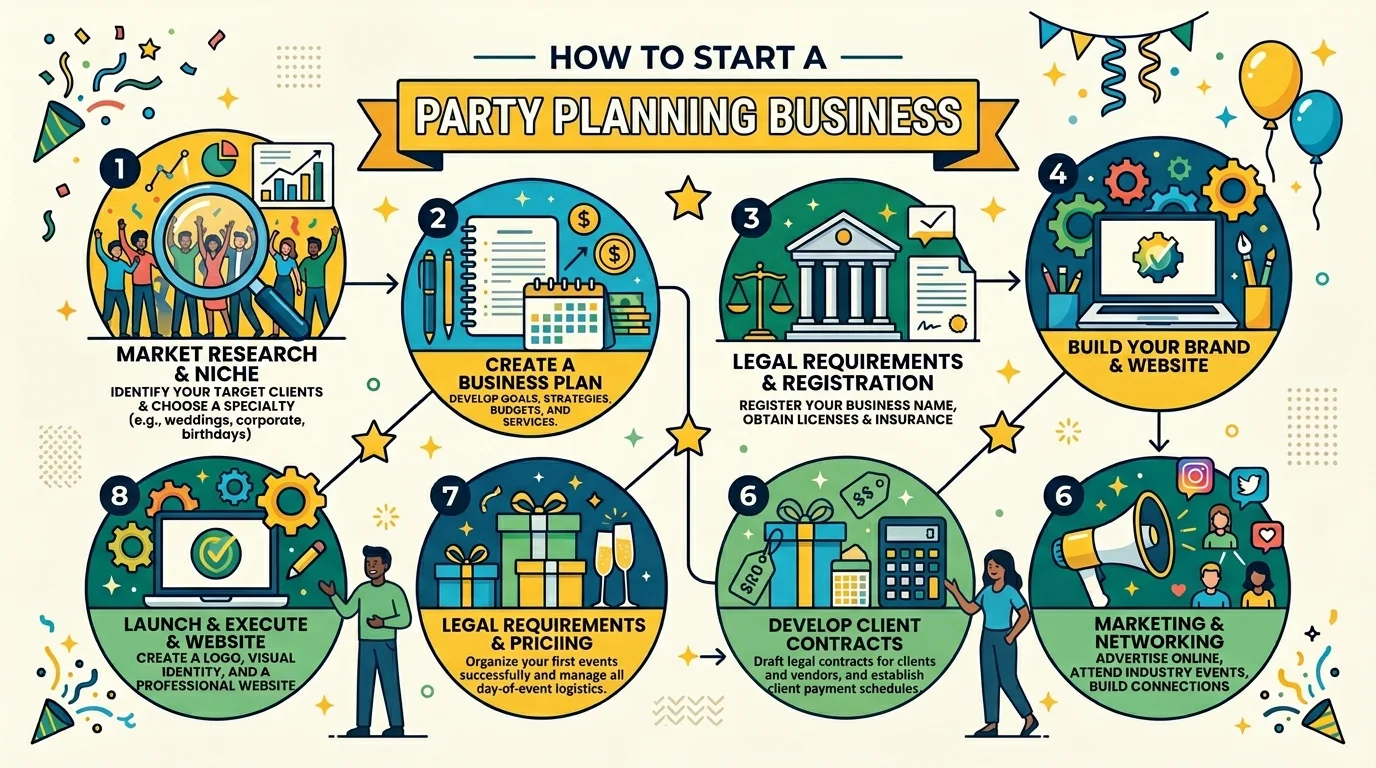
How to Start a Party Planning Business From Home: 2026 Edition
Working from home in 2026 isn’t just accepted — it’s expected. Learning how to start an event planning business at home gives you a massive advantage because your overhead stays extremely low.
The Home-Based Advantage
- No rent for office space
- No commuting costs
- Tax deductions for home office (you can deduct a portion of your rent/mortgage, utilities, and internet)
- Flexible schedule
- Lower stress
Making It Work From Home
Client meetings: Meet clients at coffee shops, their homes, or the event venue. In 2026, many initial consultations happen over Zoom or Google Meet anyway. Virtual consultations have become completely normal and even preferred by many clients.
Inventory storage: As you grow, you’ll accumulate decorations, backdrops, linens, and supplies. Options for storage:
- Spare bedroom or closet
- Garage (with proper shelving and organization)
- Rented storage unit ($50-200/month depending on size and location)
- Self-storage pods that sit in your driveway
Professional boundaries:
- Set specific work hours and communicate them to clients
- Have a dedicated workspace (even if it’s small)
- Use a separate business phone number (Google Voice is free)
- Dress professionally for client meetings and video calls
- Don’t let work bleed into family time
Zoning laws: Some cities have restrictions on running businesses from home. Check your local zoning ordinances. In most cases, a home-based event planning business (where you’re not hosting clients at your home) is perfectly fine. But it’s always smart to verify.
How to Start an Event Decorating Business in 2026
If full-service planning feels overwhelming, learning how to start event decor business is a perfect entry point. Many of today’s top event planners started as decorators.
The Decoration Specialties Blowing Up in 2026
Balloon installations: This is a massive industry on its own. Balloon arches, organic balloon garlands, balloon walls, balloon ceilings — people are obsessed. The best balloon artists charge $500-$5,000+ per installation.
LED and neon signs: Custom LED signs (“Happy Birthday, Sarah!” or “The Johnsons Est. 2024”) are a hot rental item.
Projection mapping: Turning ordinary walls into immersive visual experiences using projectors. This is the cutting edge of event décor in 2026.
Sustainable décor: Dried flowers, potted plant centerpieces, reusable fabric backdrops, and recycled material installations. The eco-conscious market is huge and growing.
Maximalist/dopamine décor: Bold colors, mixed patterns, unexpected combinations. The minimalism trend is fading — more is more in 2026.
Getting Started as an Event Decorator
Learn your craft:
- YouTube tutorials (free and endless)
- Udemy and Skillshare courses ($15-30)
- In-person workshops from established decorators
- Practice, practice, practice on your own events
Starting inventory ($200-$700):
- Balloon pump and assorted balloons ($50)
- Backdrop stand and frames ($40-80)
- Artificial flowers and greenery ($50-100)
- Table runners and linens ($30-60)
- LED string lights and battery candles ($30)
- Hot glue gun and crafting supplies ($20)
- Storage bins ($30-50)
Build your portfolio fast:
- Style a mock event at home and photograph it
- Offer free or discounted decorations for friends’ events
- Collaborate with photographers who need styled shoots for their portfolios
- Volunteer to decorate for community or nonprofit events
Pricing Event Decoration Services in 2026
| Service | Average Price |
|---|---|
| Basic balloon garland (6-8 ft) | $150 – $350 |
| Full balloon arch (10+ ft) | $300 – $800 |
| Table centerpiece (per table) | $25 – $100 |
| Complete table styling (per table) | $75 – $200 |
| Backdrop design and setup | $200 – $1,500 |
| Full venue transformation | $1,000 – $10,000+ |
How to Start Your Own Kiddies Party Business in 2026
Kids’ parties are recession-resistant. Parents will cut their own spending before they cut their child’s birthday party budget. This makes learning how to start a kiddies party business one of the safest bets in the events industry.
2026 Kids’ Party Trends
- Immersive theme parties — Going beyond decorations to create full experiences (think mini Disneyland in a backyard)
- STEM parties — Science experiments, robotics, coding activities
- Nature/outdoor adventure parties — Bug hunts, camping themes, garden parties
- Sensory parties — Designed for toddlers with sensory activities
- Character/cosplay parties — Professional character performers are in huge demand
- Art studio parties — Painting, pottery, craft-making
- Gaming parties — Fortnite, Minecraft, Roblox themes with actual gaming stations
- “Experience” parties — Cooking classes, dance parties, sports clinics
Building a Kids’ Party Package
Create packages that are easy for parents to understand and choose:
Example 2026 packages:
🎈 Fun Package ($450)
- Theme consultation
- Decoration setup and cleanup
- Custom backdrop
- Themed tableware and settings
- Setup/breakdown: 2 hours before, 1 hour after
🎉 Party Package ($850)
- Everything in Fun Package
- Entertainment coordination (character performer, face painter, or DJ)
- Party favor bags for 15 guests
- Timeline management
- Day-of coordination
🌟 Ultimate Package ($1,500)
- Everything in the Party Package
- Custom cake/dessert arrangement
- Professional photographer (1 hour)
- Premium decoration upgrade (balloon installation + floral accents)
- Guest activities station (craft corner, game zone)
- Full planning from concept to cleanup
Keys to Success in Kids’ Party Planning
- Safety is everything. Research age-appropriate activities. Ask about allergies. Have a safety checklist for every event.
- Build relationships with parents. The parent is your client, but the child is your audience. Make both happy.
- Create a referral system. Offer existing clients $50 off their next party for every referral that books. Parents talk to other parents constantly.
- Partner with kids’ venues. Indoor playgrounds, trampoline parks, community centers, and recreation centers are natural partners.
- Seasonal marketing. Birthday parties happen year-round, but certain themes peak at certain times. Market outdoor parties in spring, pool parties in summer, Halloween parties in October, and holiday parties in November/December.
How to Start an Event Space Rental Business in 2026
The venue industry is booming. Unique, Instagram-worthy spaces are in massive demand. Here’s how to start an event space rental business.
What Makes a Space “Rentable” in 2026
People don’t just want a room. They want a vibe. The most successful event spaces in 2026 have:
- Natural lighting (floor-to-ceiling windows are gold)
- Interesting architectural details
- Photo-worthy corners and backdrops
- Flexible layouts
- Outdoor access (gardens, patios, courtyards)
- Modern amenities (Wi-Fi, charging stations, quality sound systems)
- Parking or easy public transit access
Types of Event Spaces That Work
- Converted warehouses and industrial lofts
- Barns and farmhouses
- Rooftop terraces
- Art galleries (rented during off-hours)
- Backyards and gardens (yes — residential venue rentals are trending hard in 2026)
- Community halls with modern renovations
- Pop-up spaces in unused retail locations
- Renovated garages (the “garage venue” trend is real)
Legal Requirements
- Zoning approval for event use
- Fire safety inspection and certificate
- Business license
- Commercial property insurance ($1,500-$6,000/year)
- General liability insurance
- Liquor license or BYOB policy
- Noise ordinance compliance
- ADA accessibility compliance
- Health department permits (if food service is involved)
Getting Bookings
List your space on:
- Peerspace (the Airbnb of event spaces)
- Splacer
- EventUp
- The Knot and Zola (for wedding venues)
- Tagvenue
- Your own website with a booking calendar
Marketing Your Party Planning Business in 2026
The best party planner in the world is useless if nobody knows they exist. Marketing is the engine that drives your business. Here’s how to build an event planning business through smart marketing.
Content Marketing Strategy
In 2026, content is still king. But not just any content — valuable, entertaining, and authentic content.
Create a content calendar with themes for each week:
- Monday: Party tip or hack
- Wednesday: Behind-the-scenes / work in progress
- Friday: Inspiration or portfolio showcase
- Weekend: Event day content (Stories and Reels)
Content that works in 2026:
| Content Type | Platform | Why It Works |
|---|---|---|
| Party transformation Reels | Instagram, TikTok | Visually satisfying, highly shareable |
| “Plan with me” vlogs | TikTok, YouTube | Builds trust, shows expertise |
| Tips carousels | Saved and shared, builds authority | |
| Client testimonial videos | All platforms | Social proof is everything |
| Trend commentary | TikTok, Instagram | Positions you as an expert |
| Pinterest party boards | Drives website traffic for months | |
| Blog posts | Website | SEO gold, attracts Google searchers |
| Email newsletters | Nurtures leads, drives bookings |
Local SEO: Getting Found in Your City
When someone in your city searches “how do i start a party planning business” or more importantly “party planner near me,” you want to be the first result.
Local SEO checklist for 2026:
✅ Complete Google Business Profile with photos, services, and hours
✅ Collect Google reviews (aim for 10+ within your first 3 months)
✅ Optimize your website for local keywords (“party planner in [city]”)
✅ Get listed in local directories (Yelp, Thumbtack, Bark, Yellow Pages)
✅ Create location-specific content on your blog
✅ Get backlinks from local businesses and media
✅ Ensure your name, address, and phone number (NAP) are consistent everywhere online
Networking in 2026
Don’t underestimate the power of real human connection.
Where to network:
- Local Chamber of Commerce meetings
- BNI (Business Network International) chapters
- Wedding expos and bridal shows
- School PTA events (for kids’ party planners)
- Industry conferences (The Special Event, Catersource, ILEA Live)
- Local vendor open houses
- Nonprofit galas and charity events
- Co-working spaces (great for meeting corporate contacts)
Networking tip for 2026: Don’t just show up and hand out business cards. Build genuine relationships. Follow up within 24 hours. Connect on LinkedIn and Instagram. Offer value before asking for anything. The planners who network authentically book more events than those who just “sell.”
Referral Marketing
Word of mouth is still the #1 source of new business for event planners. Make it systematic:
- Ask every happy client for a referral
- Create a formal referral program (“Refer a friend, get $75 off your next event”)
- Send thank-you gifts to people who refer clients
- Ask vendors to refer you (and refer them in return)
- Include referral cards in every event’s party favor bag
Paid Advertising
Once you’re established, consider investing in targeted ads:
- Instagram/Facebook Ads: Target people in your area who are engaged, have upcoming birthdays, or follow party-related accounts. Start with $5-10/day.
- Google Ads: Target searches like “party planner [your city]” or “birthday party planning service near me.” These are high-intent searches — people are actively looking for your service.
- Pinterest Ads: Great for wedding and party planners. Target users searching for party themes and planning tips.
Getting Your First Clients: Proven 2026 Strategies
This is what separates talkers from doers. Landing your first clients when nobody knows your name. Here’s exactly how to start as an event planner when you’re starting from zero.
Strategy 1: The “Portfolio Builder” Approach
Your first 2-3 events should be free or heavily discounted. I know that stings, but listen — you need:
- Professional photos for your portfolio
- Real testimonials
- Practice and experience
- Content for social media
How to do it:
- Reach out to 5 friends or family members who have upcoming celebrations
- Offer to plan or decorate their event for free (or at a deep discount)
- Hire a photographer (or use your phone with a ring light) to document everything
- Get a written or video testimonial from the host
- Post the photos and testimonial on your website and social media
This phase should last no more than 2-4 weeks. Then start charging full price.
Strategy 2: The “Launch Announcement” Blast
Send a personal message to every single person you know:
“Hey [Name]! I’m excited to share that I just launched [Business Name] — a party planning business specializing in [your niche]. I’m offering a special 25% launch discount for my first 5 clients. If you or anyone you know has a celebration coming up, I’d love to help make it amazing! Here’s my website: [link]. Thanks for your support! 🎉”
Send this via text, email, DM, and post it on all your social media. You’ll be shocked at how many people respond.
Strategy 3: Venue Partnerships
Contact 10-15 local venues (restaurants with private rooms, community centers, parks, hotels) and introduce yourself. Offer to be their recommended party planner. Many venues don’t have an in-house planner and are thrilled to have someone to refer their clients to.
Strategy 4: Join Local Facebook Groups
Find every relevant Facebook group in your area — parenting groups, neighborhood groups, women’s groups, business groups. Don’t spam your services. Instead, be helpful. Answer questions about party planning. Share tips. When someone asks “Does anyone know a good party planner?” — you’ll be top of mind.
Strategy 5: Collaborate with Complementary Businesses
Partner with:
- Bakeries (they can refer clients who need full party planning)
- Florists (they see wedding and event clients constantly)
- Photographers (they’re at events and know who needs planning help)
- Rental companies (their clients are planning events)
Create mutual referral agreements where you send business back and forth.
Strategy 6: Social Media Giveaway
Host a giveaway: “Win a FREE party decoration package worth $500!”
Rules:
- Follow your account
- Like the post
- Tag 3 friends who love parties
- Share to their Story for a bonus entry
This can grow your following by hundreds or even thousands in a few days and generate real leads.
Strategy 7: Offer Free Consultations
Offer a free 30-minute consultation to anyone interested. No obligation, no pressure. Use this time to understand their needs, showcase your expertise, and build rapport. A good consultation converts into a booking about 40-60% of the time.
How to Run a Successful Event Planning Business: Long-Term Strategies
Starting is exciting. Sustaining is where the real work happens. Here’s how to run a successful event planning business year after year.
Over-Deliver on Every Event
Exceed expectations. Every. Single. Time.
Add a small unexpected touch:
- A handwritten thank-you card for the host
- A follow-up email with professional photos from the event
- A surprise decoration element they didn’t ask for
- A “memory book” where guests wrote notes during the party
These cost almost nothing but create raving fans who tell everyone about you.
Systematize Your Business
Create repeatable systems for:
- Client onboarding: Welcome email sequence, questionnaire, contract, payment processing
- Event planning workflow: Step-by-step checklist from booking to completion
- Vendor coordination: Communication templates, confirmation checklists
- Post-event process: Follow-up email, review request, referral ask, portfolio update
Systems save time, reduce errors, and make your business scalable. Document everything in Notion or Google Drive so you (or future team members) can follow the same process every time.
Track Your Numbers Religiously
Review these metrics monthly:
- Revenue: Total money coming in
- Expenses: Total money going out
- Net profit: What you actually keep
- Average event value: Your revenue ÷ number of events
- Booking rate: Inquiries ÷ bookings (aim for 30-50%)
- Client acquisition cost: Marketing spend ÷ new clients gained
- Customer lifetime value: Average revenue per client over their lifetime with you
Numbers don’t lie. They tell you what’s working, what isn’t, and where to focus your energy.
Keep Learning and Evolving
The events industry moves fast. Stay current:
- Follow industry publications (BizBash, Special Events Magazine, Catersource)
- Attend at least one industry conference per year
- Take online courses (new techniques, new tools, new trends)
- Follow top event planners on social media for inspiration
- Join professional organizations (ILEA, MPI, NACE)
Consider getting certified:
- CSEP (Certified Special Events Professional)
- CMP (Certified Meeting Professional)
- CPCE (Certified Professional in Catering and Events)
Certifications aren’t required, but they boost credibility and justify higher pricing.
Build Relationships, Not Transactions
Remember clients’ names, their kids’ names, their favorite colors and their preferences. Send birthday cards. Check in after events. Follow them on social media and genuinely engage.
The party planning business is a relationship business. Your best marketing channel will always be the relationships you build.
Common Mistakes That Kill Party Planning Businesses
Learning how to create a party planning business means learning what NOT to do.
Mistake 1: No Written Contract
Never — and I mean NEVER — do an event without a signed contract. Even for friends. Even for small events. Your contract protects you legally and sets clear expectations.
Mistake 2: Undercharging
New planners often price too low out of fear. Cheap prices attract cheap clients who complain the most and value your work the least. Price based on value, not fear.
Mistake 3: Saying Yes to Everything
Not every client is your client. Not every event is worth your time. It’s okay to say no to events that don’t fit your niche, your schedule, or your values.
Mistake 4: Skipping Insurance
One incident — a guest injury, property damage, a vendor no-show — can bankrupt you without insurance. Get insured before your first event.
Mistake 5: Ignoring Taxes
Set aside 25-30% of every payment for taxes. Make quarterly estimated payments to the IRS. Hire an accountant or use tax software. Not planning for taxes is the #1 financial mistake new business owners make.
Mistake 6: No Online Presence
In 2026, being invisible online is being invisible, period. Your website and social media are non-negotiable.
Mistake 7: Trying to Do Everything Alone
Delegate. Use vendors. Hire assistants for event days. You’re a coordinator, not a one-person army. Trying to do everything yourself leads to burnout, mistakes, and lower-quality events.
Mistake 8: Not Collecting Reviews and Testimonials
After every successful event, ask for a review. Make it easy — send them a direct link to your Google Business Profile. Reviews are the lifeblood of your online reputation.
Mistake 9: Comparing Yourself to Established Planners
That planner with 50,000 Instagram followers started at zero, just like you. Focus on your own journey, your own growth, and your own clients.
Mistake 10: Forgetting to Enjoy the Process
You started this because you love celebrations. Don’t let the business side kill the joy. Celebrate your own milestones — your first client, your first five-star review, your first $10,000 month. You deserve to party too.
Scaling Your Business: From Solo Planner to Event Empire
Once your foundation is solid and clients are flowing, it’s time to grow. Here’s how to build an event planning business that goes beyond just you.
Hire Support
Your first hires don’t need to be full-time employees:
- Event-day assistants ($15-25/hour) — Help with setup, coordination, and breakdown
- Virtual assistant ($10-30/hour) — Handle emails, scheduling, social media
- Freelance designers ($20-50/hour) — Help with decoration and styling
- Bookkeeper ($200-500/month) — Keep your finances organized
As revenue grows, transition to part-time or full-time team members.
Expand Your Services
Natural expansion path:
- Start with one event type (e.g., kids’ parties)
- Add related services (e.g., baby showers, family celebrations)
- Expand to new demographics (e.g., adult milestones, corporate events)
- Add complementary businesses (e.g., event decor rentals, party supply sales)
Create Passive and Semi-Passive Income Streams
Not all revenue needs to come from planning individual events:
- Decoration rentals: Build an inventory of items (backdrops, signs, tableware) and rent them to DIY planners
- Digital products: Sell party planning templates, checklists, and printables on Etsy or Gumroad
- Online courses: Teach aspiring event planners how to get started
- YouTube/TikTok monetization: Build an audience and earn ad revenue
- Affiliate marketing: Recommend products you love and earn commissions
- Party supply boxes: Curated boxes with everything needed for a themed party, shipped to customers
Open an Event Space
If finances allow, investing in your own event space combines venue revenue with planning revenue. You can host events, rent the space to other planners, and use it as your office and studio.
Franchise or License Your Brand
If you build truly excellent systems and a strong brand, you can license your model to other planners in different cities. This is a long-term vision, but several party planning companies have scaled this way nationally.
Financial Reality Check: 2026 Startup Costs
Bare Minimum Budget: $150-$350
| Item | Cost |
|---|---|
| LLC registration | $50-150 |
| Domain name | $10-12 |
| Google Voice (business phone) | Free |
| Canva (free tier) | Free |
| Google Workspace | $7.20/month |
| Business cards | $25 |
| Initial supplies | $50-100 |
Recommended Starter Budget: $800-$2,000
| Item | Cost |
|---|---|
| Everything above | ~$300 |
| Website (Squarespace annual plan) | $192/year |
| Business insurance | $350-800/year |
| Decoration starter inventory | $200-400 |
| Professional headshots | $150-250 |
| HoneyBook or Dubsado (CRM) | $16-20/month |
| Social media ads (first month) | $100-200 |
Full Professional Launch: $2,500-$5,500
| Item | Cost |
|---|---|
| Everything above | ~$1,500 |
| Professional logo design | $150-400 |
| Branded photography session | $300-500 |
| Advanced decoration inventory | $500-1,000 |
| AI tools subscription (ChatGPT Plus, etc.) | $20/month |
| Online course/certification | $200-500 |
| Marketing budget (first 3 months) | $300-600 |
| Event planning software | $20-40/month |
Bottom line: You can start this business for less than the cost of a nice dinner out. Don’t let money be your excuse.
2026 Industry Statistics You Should Know
These numbers help you understand the market and make smart decisions:
- The U.S. events industry is projected to reach $6.8 billion by the end of 2025
- 73% of event planners are women (there’s room for everyone, but know your industry)
- Average event planner salary in the USA: $55,000 – $80,000
- Top 10% of event planners earn: $100,000 – $150,000+
- 82% of event bookings start with an online search
- 91% of consumers read online reviews before hiring a service provider
- 68% of event clients prefer to see a portfolio before booking
- The average ROI for event businesses is 25-40% profit margin
- Wedding planning is the highest-paying event niche, followed by corporate events
- Kids’ party planning has the highest volume of repeat clients
A Day in the Life of a Party Planner in 2026
7:30 AM — Check emails and respond to overnight inquiries. Use AI to draft initial responses.
8:30 AM — Virtual consultation with a new client via Zoom. Discuss their vision for a 40th birthday party.
9:30 AM — Use ChatGPT to brainstorm theme ideas based on the client conversation. Create a mood board in Canva.
10:30 AM — Drive to a venue to do a walkthrough for an upcoming corporate holiday party.
12:00 PM — Lunch meeting with a caterer to discuss a new partnership.
1:30 PM — Film a TikTok showing decoration tips. Schedule Instagram posts for the week using Later.
2:30 PM — Send a proposal to last week’s consultation client. Include pricing, timeline, and mood board.
3:30 PM — Order supplies from Amazon and a specialty party supplier for Saturday’s event.
4:30 PM — Update Notion project boards. Confirm all vendors for this weekend’s events.
5:00 PM — Review finances in Wave. Send two outstanding invoices.
5:30 PM — Done! (Unless there’s an evening event to coordinate.)
No two days look the same. That’s what makes this career so exciting.
Frequently Asked Questions
How much does it cost to start a party planning business in 2026?
You can start for as little as $150-350 with a bare minimum setup. A professional launch with branding, website, insurance, and initial inventory costs $2,000-5,500. The key advantage of this business is that you can start small and reinvest profits to grow.
Do I need any qualifications to become an event planner?
No formal degree is required. What matters most is your organizational skills, creativity, communication ability, and willingness to learn. Certifications like the CSEP or CMP can boost credibility but aren’t mandatory. Many of the most successful planners in America are entirely self-taught.
Can I really start a party planning business with no experience?
Absolutely. Everyone starts at zero. Begin by planning events for friends and family, volunteer for community celebrations, study online courses, and learn from experienced planners on social media. You’ll build experience faster than you think once you start actively doing the work.
How do I start my own event planning business with no money?
Start as a coordination-only planner — you plan and manage while the client pays vendors directly. Use free tools (Canva, Google Workspace, social media, Wave accounting). Invest your first earnings back into the business. Many six-figure event planners started with literally nothing.
How long does it take to get profitable?
Most party planning businesses reach profitability within 2-6 months with consistent effort. Some planners book their first paid client within the first week. The timeline depends on your marketing intensity, local demand, and pricing strategy.
What’s the difference between a party planner and an event planner?
Party planners typically focus on social celebrations (birthdays, showers, anniversaries). Event planners may also handle corporate functions, conferences, and large-scale public events. The skills are largely the same — the main differences are clientele type and event scale. Many professionals do both.
Is party planning a good side hustle in 2026?
Yes — it’s one of the best. Most social events happen on weekends, so you can keep your day job while building your business. Many successful full-time planners started as weekend side hustlers who gradually transitioned when their event income matched their salary.
What insurance do I need for a party planning business?
At a minimum, you need General Liability Insurance ($350-$1,200/year). You should also consider Professional Liability (E&O) Insurance and, if you use your car for business, Commercial Auto Insurance. If you hire employees, Workers’ Compensation is required in most states.
How do I handle clients who want to negotiate my prices?
Stand firm on your value. You can offer to adjust the scope of services (reduce what’s included) rather than reducing the price. If a client can’t afford your prices, they’re not your ideal client — and that’s okay. There’s a client out there willing to pay what you’re worth.
What are the biggest 2026 trends in party planning?
AI-personalized experiences, sustainable/eco-friendly events, immersive themed celebrations, nostalgia parties (90s and Y2K themes), micro-celebrations, dopamine décor (bold and colorful), tech-integrated events (AR, projection mapping), and wellness-focused gatherings (sound baths, yoga brunches).
How do I compete with established event planners in my area?
You don’t need to compete directly. Find your unique angle — a specific niche they don’t serve, a unique aesthetic, better social media presence, more responsive communication, or a personality that attracts a different type of client. In 2026, authenticity and personal connection often beat experience and reputation.
Should I specialize or offer all types of event planning?
Specialize first. Become known as the best at one thing (kids’ parties, intimate weddings, corporate team events, etc.). Once you’ve established yourself, you can expand into additional event types. Specialists attract more clients and can charge higher prices than generalists.
How do I stay organized managing multiple events?
Use project management tools like Notion, Trello, or Asana. Create a master timeline for each event. Use a CRM (like HoneyBook or Dubsado) to track client communications, contracts, and payments. Develop checklists and templates for every type of event you plan. Systems are your sanity.
Can I start a party planning business in a small town?
Absolutely. Small towns have less competition, and word of mouth spreads even faster in close-knit communities. You might also serve surrounding towns and rural areas. Your pricing may be lower than in a big city, but your expenses are also lower. Many successful planners thrive in small-town markets.
What’s the best social media platform for party planners in 2026?
Instagram and TikTok are tied for first place. Instagram is best for portfolio showcase and established audiences. TikTok is best for reaching new audiences and going viral. Use both. Pinterest is third — perfect for driving website traffic from people actively planning events.
Your Next Step: Start Today
You just read everything you need to know about how to start a party planning business in 2026. Every step. Every strategy. Every tool. Every warning.
Now comes the part that actually matters: doing it.
Not tomorrow. Not next week. Not “when the timing is right.” Today.
Here’s your action plan for the next 7 days:
Day 1: Decide your niche and write your positioning statement.
Day 2: Choose your business name. Check availability for the domain and social media handles.
Day 3: Register your LLC and get your EIN.
Day 4: Set up your Google Workspace email and Google Business Profile.
Day 5: Create your Instagram and TikTok accounts. Post your first piece of content.
Day 6: Reach out to 5 potential vendors and introduce yourself.
Day 7: Tell everyone you know about your new business. Send the “launch announcement” message.
That’s it. Seven days from now, you’ll have a real business. Not just a dream. Not just an idea. A real, legitimate, operating business.
Every wildly successful event planner you admire was once exactly where you are right now — nervous, excited, wondering if they could really do this.
They could. And so can you.
The celebrations industry isn’t going anywhere. People will always have birthdays. Couples will always get married. Companies will always need events. Parents will always want magical parties for their kids.
Somebody is going to plan those events and get paid well for it.
Why not you? Why not now? Why not 2026?
Go make some magic happen.
